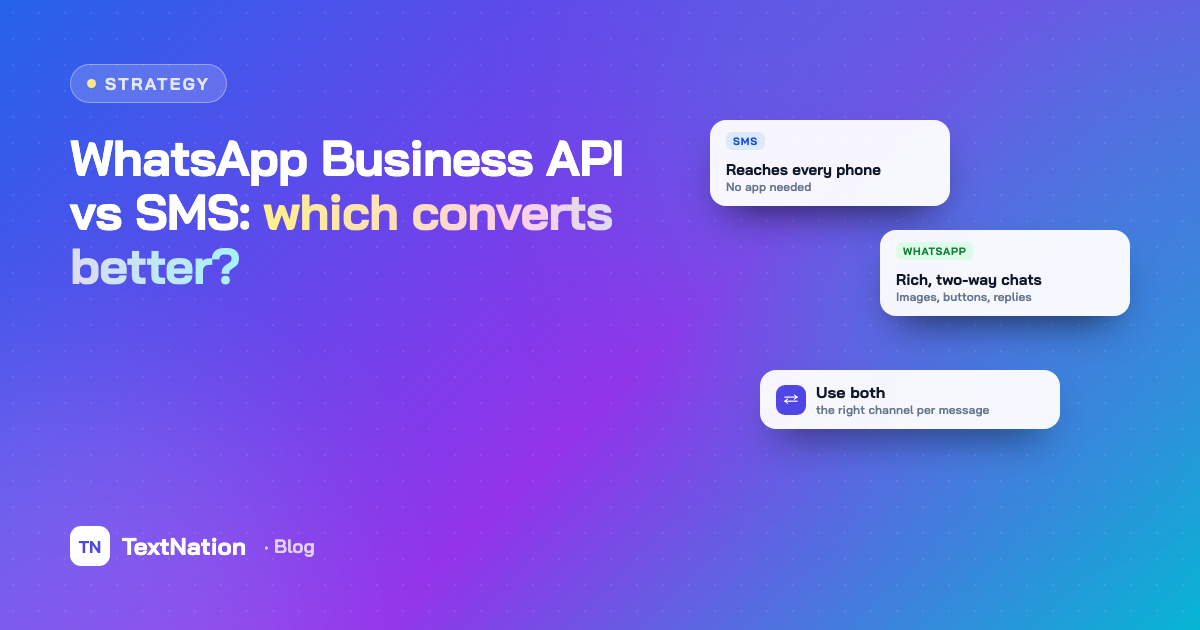
Every Indian enterprise messaging team faces the same question at some point: should we invest in WhatsApp Business API, or does SMS remain the better-performing channel for our use case? The honest answer is that it depends — but in ways that are predictable and measurable.
This article breaks down the comparison across six dimensions: reach, open rates, engagement, cost, compliance overhead, and integration complexity. We end with a use-case decision matrix so you can make the call for your specific situation.
1. Reach: Who Can You Actually Message?#
SMS#
SMS works on every mobile phone in India — from a ₹500 feature phone in rural Rajasthan to the latest iPhone. There are approximately 1.1 billion mobile subscribers in India (TRAI, 2025), and virtually all of them can receive SMS. No app installation is required. No internet connectivity is needed.
The caveat: promotional SMS cannot be delivered to numbers registered on the DND/NDNC registry. As of 2025, approximately 300 million Indian numbers are DND-registered. For transactional and OTP messages, DND restrictions do not apply.
WhatsApp#
WhatsApp has approximately 500 million active users in India, making it the world's largest WhatsApp market. However, this means roughly 55% of Indian mobile subscribers are reachable on WhatsApp — a significant gap compared to SMS.
WhatsApp requires the recipient to have the app installed and an active data connection. Users in rural areas or on older devices may not receive WhatsApp messages reliably. For this reason, enterprise platforms like TextNation offer SMS fallback — if a WhatsApp message fails to deliver within a configured window, an SMS is automatically sent instead.
2. Open Rates: Who Actually Reads the Message?#
SMS achieves a 98% open rate in India, with most messages read within 3 minutes of delivery. This is not because people love SMS — it's because the notification is inescapable and the message appears in a clean, distraction-free inbox.
WhatsApp achieves 70–80% open rates, which are substantially higher than email (20–25% in India) but lower than SMS. The gap widens for promotional messages: WhatsApp users are increasingly using the "mute" and "archive" features for business messages they find irrelevant. WhatsApp also introduced the "Recent Updates" section for business broadcasts in 2024, creating a separation from personal messages.
The critical nuance: SMS open rate measures whether the message was opened, not whether it was read. A user who opens an SMS notification without reading is counted. WhatsApp's read receipts (double blue ticks) provide a more reliable signal of genuine engagement.
3. Click-Through and Conversion Rates#
This is where WhatsApp has a clear structural advantage. WhatsApp supports interactive message types that SMS cannot match:
- ✓ Quick reply buttons (up to 3) that reduce friction to a single tap
- ✓ Call-to-action buttons with URLs or phone numbers
- ✓ Rich media: images, PDFs, videos, location pins
- ✓ Product catalogues and list messages for e-commerce
Based on aggregated data from TextNation's enterprise clients across BFSI, e-commerce, and healthcare verticals in 2025: WhatsApp interactive messages achieved a 15–25% CTR compared to 6–8% for SMS links. The highest performers were WhatsApp template messages with a single, prominent CTA button and a relevant visual.
However, SMS CTR has improved with the adoption of RCS (Rich Communication Services), which brings WhatsApp-like buttons and media to the SMS channel. For operators supporting RCS (primarily Airtel and Jio in India), RCS achieves CTRs comparable to WhatsApp at SMS-equivalent costs.
4. Cost Comparison#
Cost structures differ fundamentally between the two channels:
| Factor | SMS | WhatsApp Business API |
|---|---|---|
| Per message cost | ₹0.04–₹0.15 | ₹0.30–₹0.80 per conversation (24-hr window) |
| Pricing model | Per message | Per 24-hour conversation (not per message) |
| Free tier | None | 1,000 free conversations/month (via Meta) |
| Setup cost | Low (DLT registration) | Moderate (Meta BSP onboarding, business verification) |
| Variable costs | Flat per message | Varies by conversation category (marketing, utility, service) |
| Volume discounts | Significant at scale | Tiered by Meta; passed through by BSPs |
For high-volume transactional use cases (OTPs at 500K/day, delivery alerts, bank notifications), SMS is dramatically cheaper. The math is simple: at ₹0.08/SMS, sending 100,000 OTPs costs ₹8,000. The same volume via WhatsApp, even assuming full conversation windows, would cost significantly more.
For conversational use cases — customer support, sales qualification, post-purchase follow-up — WhatsApp's per-conversation model is often more economical than per-message SMS, because a single 24-hour WhatsApp conversation window can include many back-and-forth messages for one conversation fee.
5. Compliance Overhead#
SMS compliance: TRAI DLT#
SMS in India requires TRAI DLT registration — entity, headers, and pre-approved templates. Initial setup takes 3–7 working days. Every new message type requires a new pre-approved template. The framework is prescriptive but stable and well-documented.
Ongoing compliance: maintain templates, re-verify entity annually, pass Template IDs with every API call. The compliance overhead is moderate and largely automatable via your SMS provider.
WhatsApp compliance: Meta BSP framework#
To use WhatsApp Business API, your business must be verified by Meta and connect through an official Business Solution Provider (BSP) like TextNation. The onboarding process involves:
- Facebook Business Manager account setup and business verification
- WhatsApp Business Account (WABA) creation
- Phone number registration and verification
- Message template creation and Meta approval (usually 24–72 hours)
- Quality rating management: your templates are rated based on recipient feedback
WhatsApp's compliance framework is more dynamic than DLT. Meta can change template categories, pricing, and approval criteria with relatively short notice. Template quality ratings affect your sending limits — poor-quality templates can throttle your account. This requires active monitoring that SMS does not.
6. Use Case Decision Matrix#
Use this matrix to choose the right channel for your specific use case:
| Use Case | Best Channel | Reason |
|---|---|---|
| OTP / 2FA | SMS | 100% device reach, sub-second delivery, lowest cost, DND-exempt |
| Bank alerts & transaction notifications | SMS | Speed, reach, low cost at high volume, DND-exempt |
| Delivery tracking updates | WhatsApp (with SMS fallback) | Rich status cards, location sharing, better CX |
| Promotional campaigns | Higher CTR, richer media, no DND blocking for opted-in users | |
| Customer support | Two-way conversation, chatbot integration, file sharing | |
| Appointment reminders | WhatsApp or SMS | WhatsApp for button-based confirmations; SMS for lower-cost broad reach |
| Payment collection / invoices | PDF attachments, payment CTA buttons, higher conversion | |
| Re-engagement / win-back | Rich media, personalisation, interactive elements | |
| Emergency alerts / critical notices | SMS | Guaranteed delivery, no app required, works without data |
The Omnichannel Answer: Use Both#
The most effective enterprise messaging strategies in India do not choose one channel — they orchestrate both. The pattern that consistently delivers the best results:
- Transactional triggers → SMS. — OTPs, alerts, and confirmations go via SMS for speed and reach. Cost is minimised at high volume.
- Engagement campaigns → WhatsApp. — Marketing, re-engagement, and conversion flows go via WhatsApp for richer interactions and higher CTR among opted-in users.
- WhatsApp with SMS fallback. — For messages where delivery matters above all (payment reminders, appointment confirmations), attempt WhatsApp first and fall back to SMS automatically if undelivered within a set window.
- Measure and optimise. — Track delivery rates, open rates, CTR, and conversion per channel per campaign type. Let data drive channel allocation over time.
TextNation's unified API lets you manage SMS and WhatsApp from a single integration, with fallback logic, unified delivery reporting, and campaign analytics across both channels — eliminating the need to maintain separate vendor relationships.
SMS, WhatsApp, Voice, RCS, and Email — unified in a single integration. See how TextNation can simplify your messaging stack.
Practical guides on SMS, WhatsApp, RCS and compliance. No spam — unsubscribe any time.

The team that designs and runs TextNation's SMS, WhatsApp, RCS and voice platform. We write about new features, compliance changes and practical ways Indian businesses can reach customers better.