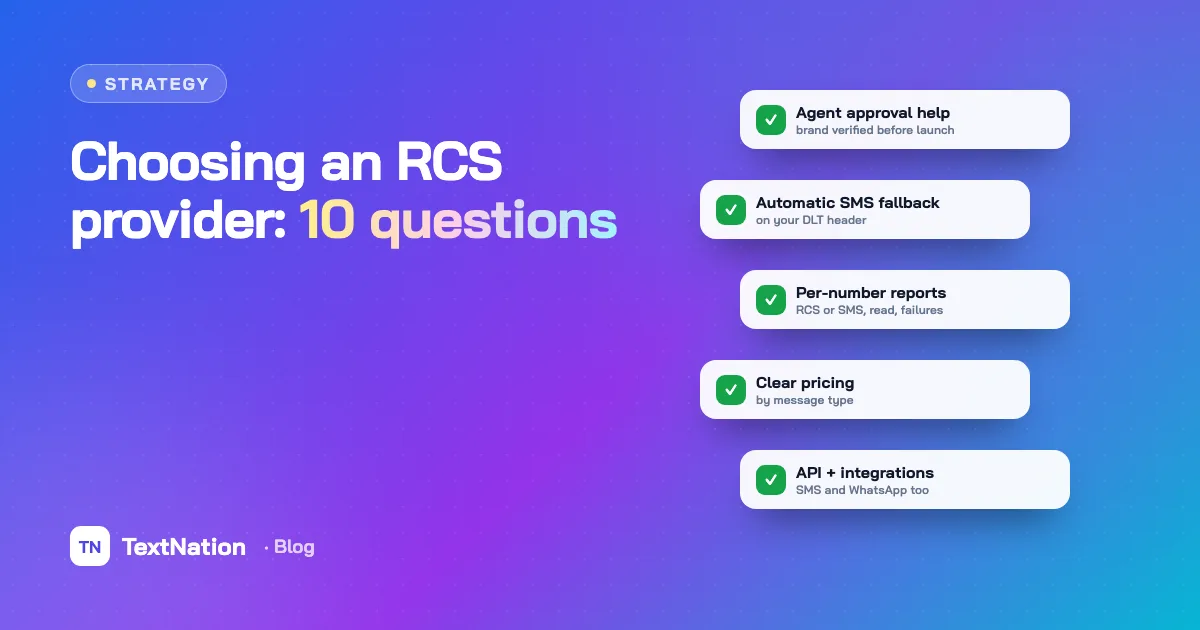
Choosing an RCS provider in India is less about who can send a rich message — most can — and more about what happens around it: getting your brand approved, reaching customers who can't receive RCS, seeing what actually happened to every message, and fitting RCS into the tools you already use.
Here are ten questions to ask any RCS business messaging provider before you commit, and what a good answer sounds like.
1. Will you help us register and verify our RCS agent?#
Your RCS sender — the agent — carries your brand name, logo, colours, description and contact details, and has to be verified and approved before it can message customers. A good provider walks you through the information needed, prepares the submission with you and tells you where it stands.
Good answer: "We'll collect what's needed, submit it, and keep you updated until it's approved."
2. Which message types can we send?#
At minimum you should be able to send plain text, rich cards (image or video with title, description and buttons) and carousels of several cards. Buttons should cover opening a link, starting a call, sharing a location and quick replies.
Ask to see: a preview of each type exactly as customers will see it.
3. What happens when a phone can't receive RCS?#
This is the most important question. Not every phone can receive RCS — older phones, some iPhones, RCS switched off, no data. Without a backup, those customers get nothing. Read Is RCS available in India? for why.
Good answer: "Automatic SMS fallback on your DLT-registered header and approved template — set once per campaign."
4. Can we see what happened to every number?#
Totals aren't enough. You need to know, per number, whether the message was delivered or read, whether it went out as RCS or SMS, and why it failed if it did. You should also be able to export it for your team.
Ask to see: the sent-message list and the usage report for a real campaign.
5. How is RCS charged — and how is fallback charged?#
RCS is billed per event: basic messages, rich messages and conversations are priced differently, and SMS fallback is charged as SMS. Make sure the provider explains each line. Our guide to how RCS is charged in India lists the questions to ask.
6. Can our systems send RCS through an API?#
Most brands trigger messages from their own systems — order platforms, CRMs, core banking. You need an HTTP API for sending and delivery reports pushed back to your URL (webhooks), with your own authentication.
7. Does it work with our marketing tools?#
If your team runs campaigns from a marketing automation or CRM platform, ask whether the provider can be plugged in as the RCS (and SMS and WhatsApp) provider there, and whether delivery reports flow back into it. See our integrations for an example of what to look for.
8. What about SMS and WhatsApp?#
RCS works best next to the other channels: RCS with SMS fallback for alerts and offers, WhatsApp for conversations, SMS for OTPs on every phone. One provider for all of them means one account, one set of reports, one opt-out list, and journeys that move between channels — for example, an SMS reminder the next day if an RCS message wasn't read.
9. How do you handle opt-outs and compliance?#
Customers who opt out must stop receiving messages — on every channel, not just the one they opted out of. Fallback SMS still needs DLT-registered headers and templates. Ask how opt-outs are applied and whether they cover API and integration traffic too.
10. What happens when we send a lot at once?#
Big campaigns shouldn't hold up your OTPs and alerts. Ask how the provider queues large sends, whether time-critical traffic gets priority, and how quickly you can pause or stop a campaign.
A quick checklist#
| Question | What to look for |
|---|---|
| Agent registration | Hands-on help until approval |
| Message types | Text, rich cards, carousels, buttons, quick replies |
| Reach | Automatic SMS fallback on your DLT header and template |
| Reporting | Per number: delivered, read, RCS or SMS, failure reason; exports |
| Pricing | Clear rates by message type; fallback charged as SMS |
| API | Sending API plus delivery webhooks |
| Integrations | Works with your marketing and CRM tools |
| Other channels | SMS and WhatsApp on the same account |
| Compliance | Opt-outs on every channel and every send path |
| Scale | Priority for time-critical traffic; pause and stop controls |
The bottom line#
The best RCS provider is the one that gets your brand approved, never leaves a customer without the message, and shows you exactly what happened to every number — on the same platform as your SMS and WhatsApp.
Agent registration help, rich cards and carousels, automatic SMS fallback and per-number reports — alongside SMS and WhatsApp.
Frequently asked questions
What should I look for in an RCS provider in India?+
Why does SMS fallback matter when choosing a provider?+
Should I run a pilot before choosing?+
Practical guides on SMS, WhatsApp, RCS and compliance. No spam — unsubscribe any time.

The team that designs and runs TextNation's SMS, WhatsApp, RCS and voice platform. We write about new features, compliance changes and practical ways Indian businesses can reach customers better.