"How much does RCS cost?" is one of the most common questions brands ask before trying RCS business messaging. The honest answer is that it depends on what kind of message you send — a short text, a rich card, or a conversation are charged differently. Once you understand how RCS is billed, you can plan a mix that keeps costs predictable.
This guide explains the billing model behind RCS business messaging, what drives your bill in India, and the questions to ask any provider before you sign up.
The building block: what Google counts#
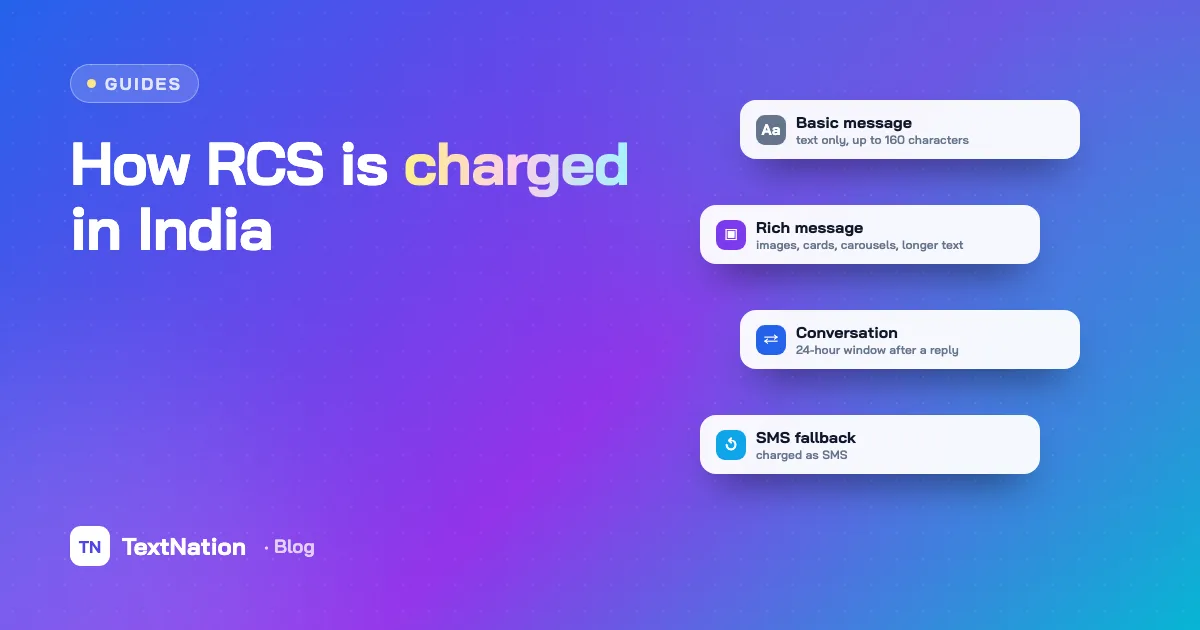
RCS business messaging runs on Google's RCS Business Messaging (RBM) platform. Google tracks every message as a billable event, and operators and providers price on top of those events. The main ones, according to Google's RBM billing documentation:
| Billable event | What it is |
|---|---|
| Basic message | A message from your business that is text only, up to 160 characters |
| Single (rich) message | A message with rich content — image, video, rich card, carousel — or text longer than 160 characters |
| Conversation | For conversational agents: messages exchanged within a 24-hour window that starts when one side replies to the other |
| Customer message | A message the customer sends to your business — operators decide whether and how these are charged |
Two details are easy to miss:
- Length changes the category. A text-only message of 161 characters is no longer a basic message — it is billed like a rich one.
- Taps are treated differently. Google's documentation says tapping a suggested action (for example "Open link" or "Call") doesn't create a billable event, while tapping a suggested reply sends a message back to the business, which does.
Conversational vs non-conversational agents#
Every RCS sender (the "agent") is set up in one of two billing categories, chosen when the agent is created:
- Non-conversational — charged per message. This is the typical setup for alerts, notifications and promotions. Google merged the older Basic Message and Single Message categories into this one on 20 November 2025, without changing which events are billed.
- Conversational — charged per conversation when the customer replies within 24 hours; a message the customer never replies to is still charged on its own.
Pick conversational only if customers will genuinely talk back — support, bookings, guided selling. For one-way traffic, per-message billing is simpler to predict.
What RCS costs in India#
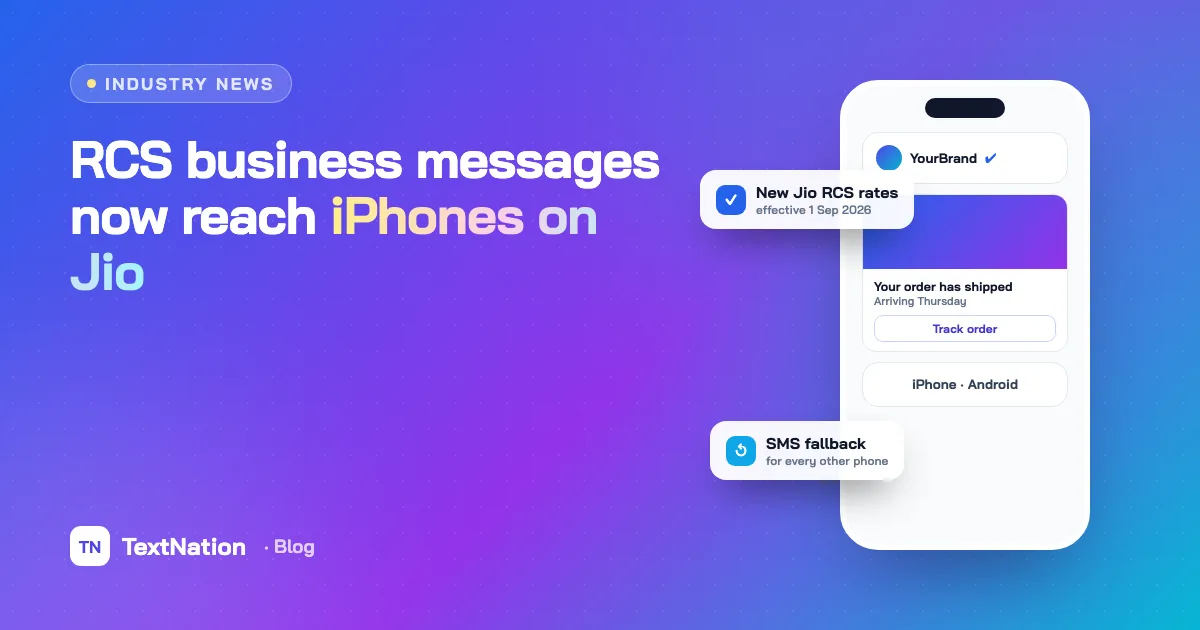
Prices are set commercially by operators and providers, so there is no single public price list. What has been published gives a sense of the range. In September 2026, Inc42 reported Jio's new RCS business messaging rates — ₹0.27–0.30 per marketing message, ₹0.25 per transactional message and ₹0.11–0.16 per OTP — replacing an earlier flat ₹0.08–0.10 per message. We covered that change in RCS business messaging now reaches iPhones on Jio.
What really drives your RCS bill#
- Your message mix. Marketing, transactional and OTP traffic are often priced differently, and so are basic and rich messages.
- Text length. Short, text-only alerts under 160 characters fall into the cheapest category. Every extra character over 160 moves the message up.
- How much goes out as SMS fallback. Numbers that can't receive RCS get your SMS instead — and that SMS is charged as SMS. The higher your RCS reach, the more of your traffic is billed as RCS.
- Replies. With a conversational agent, replies turn messages into conversations; with a non-conversational one, operators may charge for customer messages.
- Failed messages. Whether undelivered messages are charged depends on your provider's terms — ask.
How to keep RCS costs under control#
- Use rich messages where they change behaviour — product carousels, offers with a "Buy now" button, order updates with "Track" and "Reschedule".
- Keep plain alerts plain. A one-line alert doesn't need an image; keep it under 160 characters, or keep it on SMS.
- Always turn on SMS fallback. It protects reach — and your reports show exactly how much went out as SMS.
- Pilot before you scale. Run one high-volume message on RCS for a couple of weeks and compare cost per click or per conversion with SMS.
- Review the split every month. As RCS reach grows (iPhones on Jio, for example), the share of traffic billed as RCS will change.
Questions to ask an RCS provider about pricing#
- What is the price per basic message and per rich message — and for marketing, transactional and OTP traffic?
- Is my agent conversational or non-conversational, and why?
- How is SMS fallback charged, and does it use my existing DLT header and templates?
- Are undelivered messages charged?
- Are customer replies charged?
- Can I see, per number, whether a message went out as RCS or SMS?
The bottom line#
RCS is charged per billable event, and the type of message — basic, rich or conversation — sets the price. Keep simple alerts short, use rich messages where they earn their cost, and always send with SMS fallback. Then measure cost per result, not cost per message.
Tell us what you send today and we’ll show you what RCS with SMS fallback would look like — no generic price list.
Sources#
- Google for Developers — RBM billing FAQ
- Inc42 — Jio introduces new RCS business messaging rates for iPhone users in India (9 September 2026)
Frequently asked questions
How is RCS business messaging charged?+
How much does RCS cost in India?+
Is SMS fallback charged separately?+
Are button taps charged?+
Practical guides on SMS, WhatsApp, RCS and compliance. No spam — unsubscribe any time.

The team that designs and runs TextNation's SMS, WhatsApp, RCS and voice platform. We write about new features, compliance changes and practical ways Indian businesses can reach customers better.