An OTP that arrives two minutes late is an OTP that failed. The user has already tapped "Resend", given up, or switched to a competitor's app. For most Indian businesses, OTP SMS delivery is the single most visible part of the messaging stack — and the one where small configuration mistakes cost the most.
This guide walks through the nine most common reasons OTP SMS is slow or never arrives, and what to do about each. Most of them are fixable in an afternoon.
Why OTP SMS delivery is different from other messages#
A promotional SMS that lands in ten minutes is fine. An OTP usually expires in five. That changes everything about how OTP traffic should be treated:
- Speed matters more than cost. A slightly more expensive route that delivers in seconds beats a cheap route that queues.
- Every failure is visible. The user is staring at the screen, waiting.
- Volume is spiky. Logins peak in the morning and around sales; a flash sale can multiply OTP traffic in minutes.
Keep those three facts in mind — every fix below comes back to one of them.
1. The DLT template doesn't match the message#
Every commercial SMS in India must match a template approved on the TRAI DLT portal. If your OTP text differs from the approved template by even a word, an extra space or a changed variable, operators reject it. This is the most common cause of "the OTP never came".
Fix: copy the approved template text exactly, and only change what sits inside the {#var#} placeholders. Keep the OTP itself in a single variable. If you change the wording, register the new template first. Our DLT registration guide covers template rules in detail.
2. The OTP is sent on the wrong route#
OTP traffic should travel on a transactional or service route registered for it, with a header (sender ID) linked to the right template. Sending OTPs through a promotional header means DND numbers are blocked and time-window rules apply — so some users will never get the code.
Fix: check that your OTP header and template are registered under the right category, and that your provider sends them on its transactional/service route, not the bulk promotional one.
3. Phone numbers are stored in messy formats#
"98765 43210", "+91-98765-43210", "098765 43210", a number pasted from Excel with a hidden non-breaking space — they all look like the same number to a person. To a gateway, some are invalid. Numbers that arrive with invisible characters are a surprisingly common cause of silent OTP failures.
Fix: normalise every number to one format (country code plus ten digits, e.g. 919876543210) before sending, and reject entries that aren't valid mobile numbers instead of passing them to the operator. TextNation does this automatically and lists anything that isn't a mobile number in the report, uncharged.
4. OTPs wait in the same queue as bulk campaigns#
If a 2-lakh-number promotional campaign and your login OTPs share one queue, the OTPs wait their turn. That's how a marketing send at 11 am becomes a login outage at 11:02.
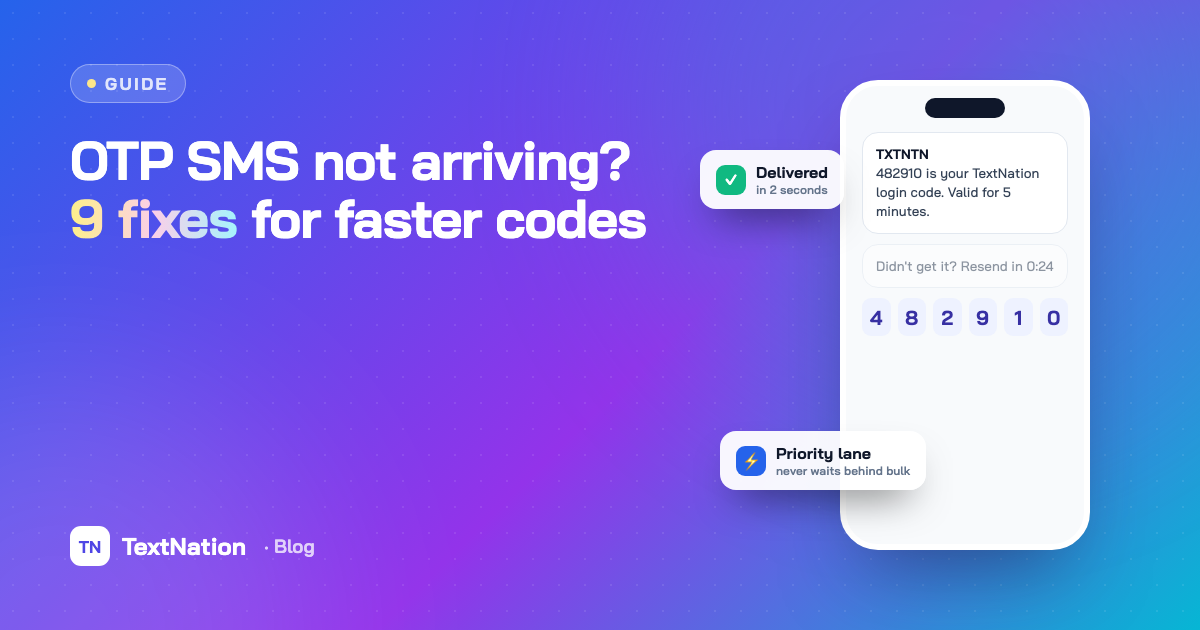
Fix: your provider should give OTP and transactional traffic its own priority lane that never waits behind bulk sends. We explain how priority queues work in how to deliver 10M+ messages daily.
5. No delivery reports are being watched#
Many teams send OTPs and never look at delivery reports. When an operator starts rejecting a template, or a route slows down, nobody notices until users complain.
Fix: track delivery status for OTP traffic separately, and alert on two numbers: the delivery rate over the last 15 minutes, and the share of messages still waiting for a delivery report. A sudden drop in either is your early warning.
6. Users tap "Resend" too fast#
When a code hasn't arrived after 10 seconds, users tap Resend. Each tap sends another OTP, invalidates the previous one, and adds load. Sometimes the first OTP arrives a moment later — and no longer works.
Fix: show a visible countdown (30–60 seconds) before Resend is enabled, keep the previous code valid until the new one is delivered, and offer an alternative channel on the second attempt rather than a third SMS.
7. There's no fallback channel#
SMS can fail for reasons outside your control: the phone is out of coverage, the inbox is full, a network is congested. If SMS is the only channel, the user is stuck.
Fix: offer a second channel. WhatsApp authentication templates are built for one-time codes, with a copy-code button, and most Indian smartphone users have WhatsApp. A voice call that reads out the code works on any phone. Offer the fallback after the first resend.
Add a second step at sign-in with a one-time code sent to your WhatsApp.
8. OTP abuse is eating your capacity#
Bots that hit your "Send OTP" endpoint with random numbers — OTP pumping — cost you money and can slow down delivery for real users. It usually shows up as a sudden spike of OTPs to numbers that never verify.
Fix: rate-limit OTP requests per number, per IP and per device; add a CAPTCHA after repeated attempts; and watch the ratio of OTPs sent to OTPs verified. A healthy flow verifies most codes — a falling ratio means someone is abusing the endpoint.
9. The message itself is hard to use#
Even a delivered OTP can fail if the user can't use it quickly. Codes buried in long text, missing the app name, or written in a way that phone keyboards can't auto-fill all slow people down.
Fix: put the code first, name your brand, say how long it's valid, and add the app hash if you use Android's SMS Retriever API so the code fills in automatically. For example: "482910 is your TextNation login code. Valid for 5 minutes. Do not share it."
A quick OTP delivery checklist#
- OTP text matches the approved DLT template exactly
- Sent on a transactional/service header, not promotional
- Numbers normalised before sending; invalid entries rejected
- OTPs have a priority lane that never waits behind bulk sends
- Delivery rate and pending reports monitored, with alerts
- Resend countdown and a fallback channel (WhatsApp or voice)
- Rate limits and abuse monitoring on the OTP endpoint
- Code first in the message, with brand name and validity
TextNation sends OTPs on a priority lane with WhatsApp and voice fallback, DLT checks and live delivery monitoring.
Frequently asked questions
Why is my OTP SMS not delivered?+
How fast should an OTP SMS arrive?+
What is a good fallback when OTP SMS fails?+
How do I stop OTP abuse or SMS pumping?+
Practical guides on SMS, WhatsApp, RCS and compliance. No spam — unsubscribe any time.

The team that designs and runs TextNation's SMS, WhatsApp, RCS and voice platform. We write about new features, compliance changes and practical ways Indian businesses can reach customers better.