If your business sends WhatsApp messages in India, your bill changed on 1 October 2026. Two kinds of messages that Meta had made free are now charged, and a billing-currency deadline is coming up at the end of the year.
Here is what changed, what it means in practice, and what to do this quarter. Everything below comes from Meta's own pricing documentation — rates themselves change, so always check the current rate card before you budget.
What changed on 1 October 2026#
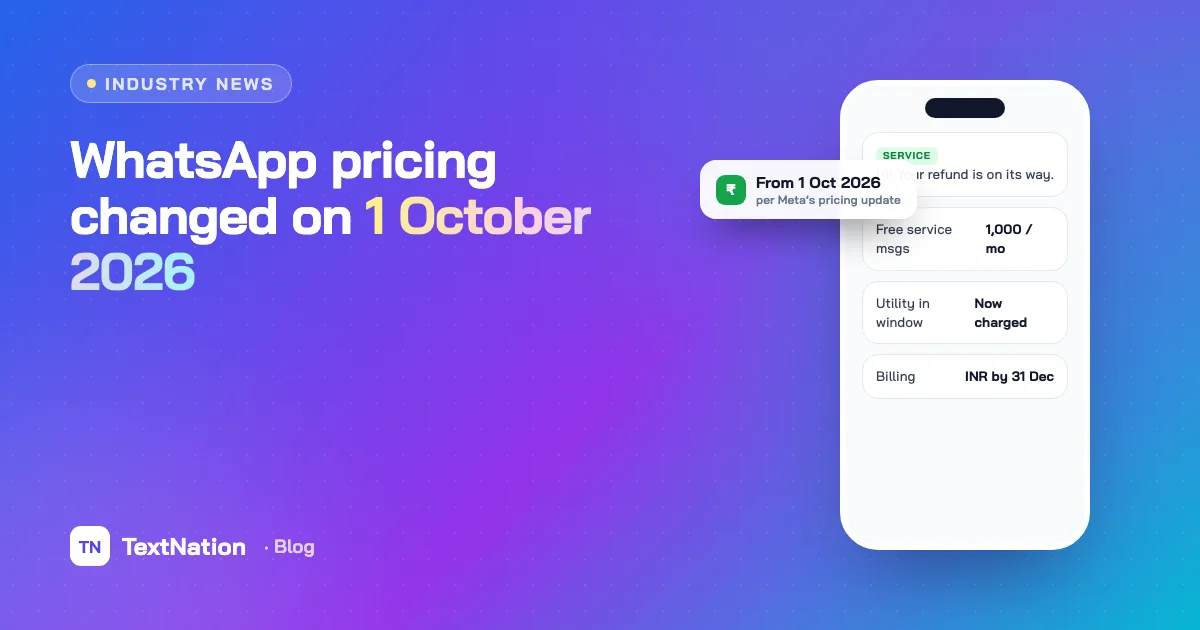
Meta charges for WhatsApp per message, by category: marketing, utility, authentication and service (replies to a customer who messaged you first). From 1 October 2026, according to Meta's pricing updates:
- Service messages are no longer free without limit. They had been free since 1 November 2024. Now each business phone number gets 1,000 free service messages per month, and messages beyond that are charged. The free allowance does not roll over.
- Utility messages inside an open customer-service window are charged. Since 1 July 2025, a utility template sent within 24 hours of the customer's last message was free. That exception has ended.
For India, Meta's October update did not list a change to the marketing, utility or authentication rates themselves — the change is in which messages are free.
The other 2026 changes Indian businesses should know#
| Date | Change (per Meta) |
|---|---|
| 1 January 2026 | India marketing rates went up; billing in Indian rupees (INR) launched for eligible accounts |
| 1 April 2026 | India's authentication-international rate went up |
| 1 October 2026 | Service messages beyond 1,000 per number per month and in-window utility messages are charged |
| 31 December 2026 | Deadline for eligible India accounts to move billing to INR |
The last one matters operationally: Meta says that from 1 January 2027 it will stop delivering messages from non-INR accounts of eligible customers that haven't migrated. If you are billed directly by Meta, check your account's currency now. If you send through a provider, ask them to confirm the migration is done.
What this means for your WhatsApp costs#
Most Indian businesses use WhatsApp in three ways, and each is affected differently:
- Customer support (service messages): small and mid-sized teams may stay within 1,000 free messages per number per month. Busy support desks will not — every message after the 1,000th is now billed.
- Order, delivery and account updates (utility): these were sometimes free when sent inside an open chat window. Now every utility template is charged.
- Campaigns (marketing): no change in October, but marketing remains the most expensive category, and the January increase still applies.
Five things to do this quarter#
- Measure your service volume per number. Find out how many service messages each WhatsApp number sends in a month. If you are near or above 1,000, the new charges apply to you.
- Check your template categories. A utility template with one promotional line can be reclassified as marketing — the most expensive category. Our guide to WhatsApp template categories explains how to keep categories right.
- Move routine replies to the right channel. Not every update needs WhatsApp. A delivery OTP or a simple alert can often go by SMS, while WhatsApp is kept for rich, two-way conversations. See WhatsApp Business API vs SMS.
- Confirm INR billing before 31 December. Ask your provider, or check your Meta account if you are billed directly.
- Watch cost per conversation, not just per message. A conversation that needs eight messages instead of three now costs more. Shorter, clearer templates and quick-reply buttons help.
TextNation shows WhatsApp spend by category and number, warns when Meta changes a template's category, and routes routine alerts to the cheapest channel that works.
Sources#
- Meta for Developers — WhatsApp Business Platform pricing updates
Frequently asked questions
What changed in WhatsApp pricing on 1 October 2026?+
Did WhatsApp rates in India change in October 2026?+
What is the WhatsApp INR billing deadline?+
Do the 1,000 free service messages roll over?+
Practical guides on SMS, WhatsApp, RCS and compliance. No spam — unsubscribe any time.

The team that designs and runs TextNation's SMS, WhatsApp, RCS and voice platform. We write about new features, compliance changes and practical ways Indian businesses can reach customers better.